AI Anxiety, Microduck and Computer Recorder
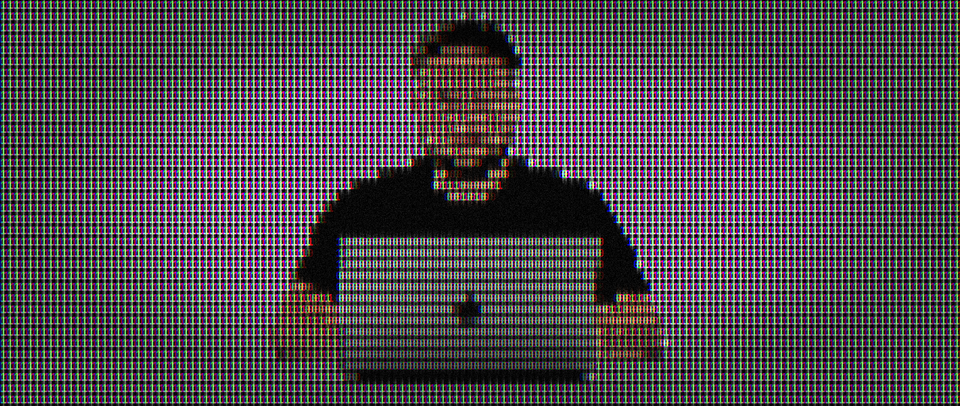
I’m exhausted, often anxious, and I think it has something to do with my use of AI.
That’s difficult to untangle, because AI changed my life for the better.
I always knew I’d enjoy making digital things, but I never learned programming. My head was full of ideas, and turning them into something real meant asking my developer friends for help.
When ChatGPT and Claude came along, I could finally create what lived in my head. I set up a server, built a talking skull with a local language model attached, and started making my first app. I learned how things worked by doing it.
We worked through problems together. I had ideas, the agent helped me implement them, and I asked questions when I didn’t understand. I was involved in the making. That was what I’d wanted all along.
Then autonomous coding agents arrived. Instead of working through every step together, I could hand over a task and come back to a result.
And it kind of works. There’s a working app I can use, a video script, or an article draft. Often, my first impression is that it’s good. Like 80% there. Almost finished.
But when I start using the output, that feeling changes.
A feature behaves strangely. A translation is off. A paragraph reads convincingly, but the argument doesn’t hold up. Small cracks everywhere.
Sure, you can publish it. Most people do. That’s why every thread on X feels the same. Why landing pages look the same. It's slop. Not because it's bad, but because it's bland.
And it's not only the design or language. When it comes to programming, the choices the agent makes on its own don't always make sense.
For my app, which helps parents record moments with their children, Claude generated 200 questions. It could easily generate another 200. But more questions wouldn’t solve the problem. I needed questions that would actually bring a memory to mind.
So I printed them out, crossed some off, and wrote new ones.
That was satisfying. My judgment mattered. It was also frustrating to discover how much work remained. Between the questions and all the other things to fix, a supposedly finished app can still require another 50 hours of my attention.
But the agent isn’t forcing me to do this. I start the projects. If I want to feel less exhausted, I could take a day off and leave the agent be.
I’ve always been obsessive about things that interest me. I can completely lose myself in a project, and I think that’s one of my best character traits. AI empowers that part of me. My skills have expanded, execution is faster, and whenever I get stuck, someone is available to help.
There is almost always a way to keep going. If I get bored of one idea, I can start working on a new one. It's also a form of procrastination. When it get's difficult (eg when I need to actually make difficult choices and think hard), I can just work on a proof of concept for a new idea.
That means I’m always behind my laptop. The weeks and months blur into one long stretch of working on things. I enjoy it. But doesn’t make it any less exhausting.
There’s another reason I find it difficult to stop: I feel like the window is closing. That’s also where my anxiety comes from, I think.
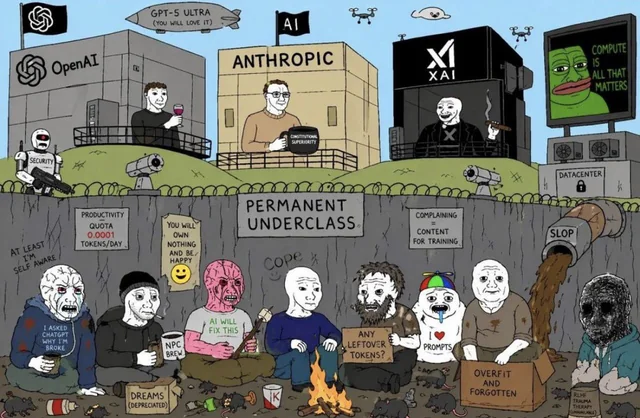
Part of that is social media. Everyone is building something. Every new model supposedly needs less human involvement. Jensen Huang says AGI is here. Astra is even better than Fable. It makes me think about the permanent underclass meme. If you miss the boat now, you’re out.
These companies live on FOMO. They need the hype, since their IPO is coming up. I can see that.
But I’ve also experienced how much better these models have become over three years. Things we once struggled through together are now straightforward. I can recognize the hype without dismissing the possibility of much bigger changes coming.
And I’ve only just gained the ability to turn my ideas into useful products, maybe even a business. It almost feels unjust. I just got here, and now the place is shutting down.
Right now, I feel that putting in the work gives me an edge. Accepting whatever the agent produces might leave me with something usable but interchangeable. An app can work without being pleasant to use. An article can read smoothly without saying anything interesting. Those aren’t necessarily mistakes I can ask the agent to correct. I have to decide what’s missing and what would make the result worth someone’s time.
My contribution goes beyond reviewing the output. I bring an idea of who it’s for, what it should feel like, and why it should exist. Sometimes working with the agent helps me figure those things out. But I still need to think, make choices, and care enough to change what isn’t good enough.
That’s the advantage I feel I have: over people who don’t use AI, but also over people who use it and stop at the first acceptable result. And, for now, over what the AI can produce without my involvement.
But how long will that contribution matter in the same way? And do we even need AGI for that? Or is the next frontier model good enough?
I like making things with my agent. If my involvement eventually shrinks to requesting something and receiving it, would I still feel like I’d made it? At what point am I just a consumer instead of a collaborator?
There’s always another idea worth testing while I can still contribute something valuable. But I don’t know what would count as having done enough.
I just finished The Infinity Machine, Sebastian Mallaby’s book about DeepMind cofounder Demis Hassabis. You should read it; it’s fantastic.
There’s a passage in which Hassabis recalls his father telling him that, whether he won or lost, what mattered was trying his best. But how could he know he’d actually done that?
“The only way I could know is basically if I pushed myself to the point just before death,” he tells Mallaby.
That stuck with me. Not because I want to take it that far, but because I recognize the logic. If there’s still more I could do, stopping feels like something I have to justify.
AI keeps expanding what I can do. I keep treating that as a reason to expect more of myself. An idea I couldn’t have executed a year ago becomes something I could start tonight. And because I’m afraid this opportunity won’t last, it's hard to leave it as just an idea.
This week I bought the Microduck. I was not the only one. Hugging Face sold more than 10,000 units in the first week. A week later, NVIDIA confirmed it was buying the company for 13 billion dollars.
The Microduck is a fully functioning robot. This in itself is not revolutionary. There are many consumer-grade robots. Take Beni, a robot that can follow you to film you and can do flips. Those don't do it for me. The gimmick factor is too high. I will use it for a month and then drop it next to my VR goggles.
What makes the Microduck different is that the software is open-source. The journey starts when the robot arrives. You can teach it to sit, stand on one leg, run, ride a skateboard.
Or teach.. Maybe that's the wrong word. You use a process called reinforcement learning. You don't use your real robot for that, but a digital twin duck in a simulator on your computer.
In the simulator, you reward the duck for moving forward or keeping its head level and deduct points for falling over. After that, you let the duck loose. Not one duck, but thousands.
It tries random movements, and it fails. But at some point, randomly, a move will stick. Kind of how evolution works. The next digital ducks will use that information and iterate on that.
The idea is that after a couple million iterations, the duck walks (or performs the action you made the scorecard for).
This is different from how we as humans learn. We learn by watching, sharing tips and tricks. When you help your child learn to ride a bike, you will tell him what to do. The duck doesn't get any tips.
That's why robots sometimes find novel (and weird) solutions to problems. Take the Tiangong Omni at the Robot Games in Beijing last month. It won the 400 meters running competition with both hands over its face. Nobody programmed that behavior. It's reinforcement learning scorecard rewarded speed and efficiency, and the digital twins of the robot figured out that this way of running was the fastest and most efficient.
Sometimes researchers do give the robot the explicit objective to mimic human behavior. Robots that perform backflips are often trained like this. We call that imitation learning.
Either way, learning is a feedback loop: try, get feedback, adjust, try again. For humans, the bottleneck is always the same. Time. And pain. Every attempt costs time, and negative feedback hurts, sometimes physically.
The duck has neither problem. Its digital twin lives in a simulation, where time and pain don't exist. You can spin up 10,000 ducks and let them fall all night. Nobody gets hurt, nobody gets tired. By morning, you have a duck that walks.
I feel the same way about the duck as I did when I first tried Midjourney or Claude Code. It's the feeling that robotics are about to take a big leap, and I want to be part of that. I want to understand how robots work, and I want my own.
My duck will arrive sometime in the next 6 months. Will keep you posted.
I made a computer recorder. It's like a screen recorder, but it also records what I'm doing on my computer. Mouse clicks, keystrokes, and even the computer language itself. So when I click on a button, the tool saves which button I clicked.
Why did I make this? Because I create tutorial videos. In those videos, I often use screen recordings. My workflow is to create a script that explains what happens in these videos.
This means going through the raw screen recordings, cutting them, and then writing the script.
Example: "... and then we click on the 'next' button in the lower right corner. In the next screen, we see the dashboard. We click the gear icon to open the settings menu. In the settings menu..."
I hear you thinking. "Sure AI could help you here, right?" Yeah, not really. AI can't watch videos. It just takes screenshots and analyses them. Only Gemini recently improved this.
So if I want the AI to help me, I need to help it first by giving context. That's what the computer recorder does. It generates additional context: mouse clicks, keystrokes, and computer info combined with timestamps.
With that context, the AI can generate screenshots at the exact right moments instead of taking them randomly. It takes screenshots on mouse clicks, input from the keyboard, and app changes.
I used it in my latest tutorial video, and it worked quite well. It still requires a lot of manual work, but the initial script was written by AI based on my screen recording.
That's it for this edition. See you next time.
Bart
Member discussion